

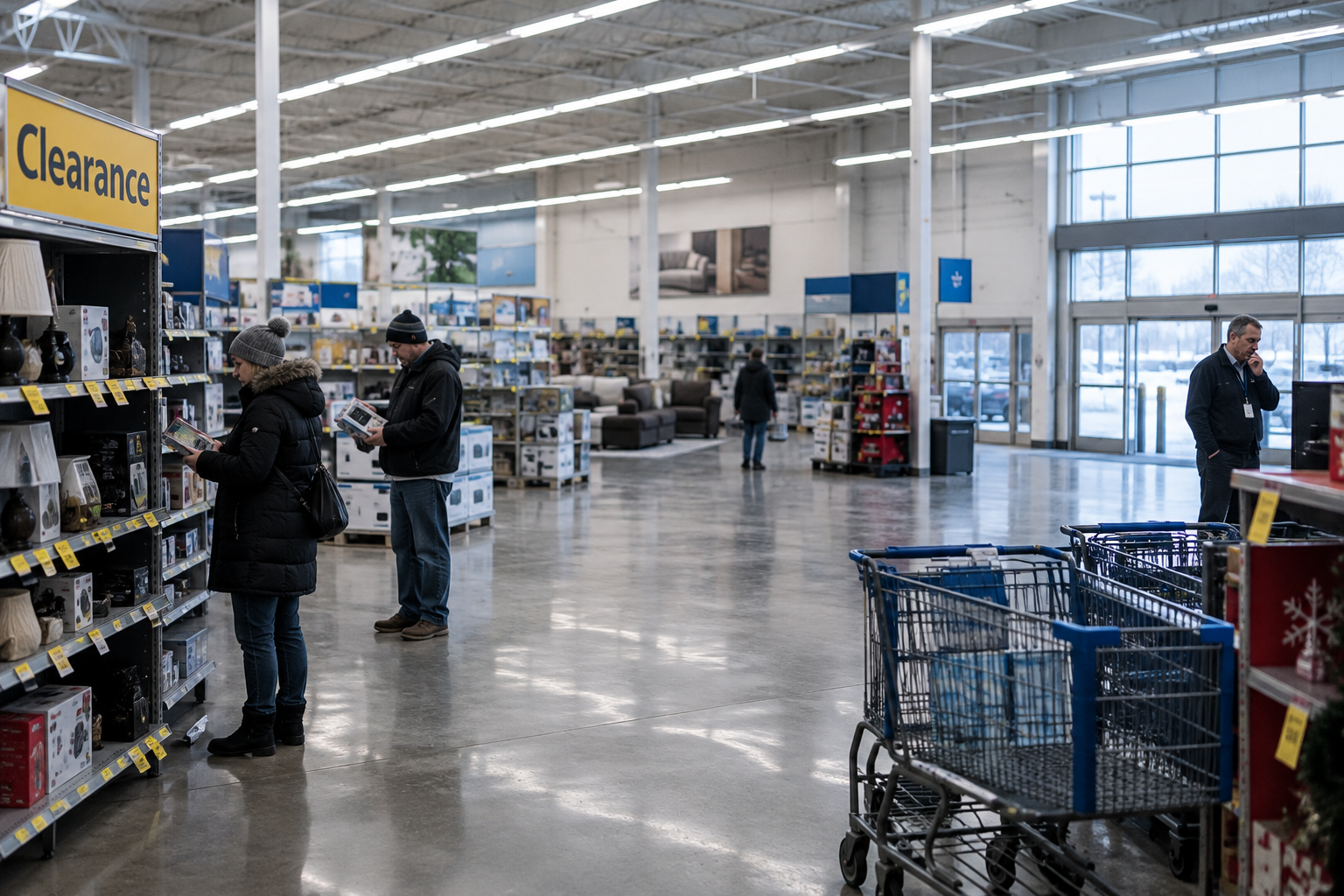
Business leaders heading into 2026 are facing a consumer environment that looks more selective, more price-conscious, and less forgiving than the one many companies grew used to during earlier periods of strong demand. A slowing consumer economy does not always mean a full recession, but it often signals a shift in buying behavior that can reshape growth plans, margins, hiring, inventory strategy, and capital allocation across nearly every industry.
For companies of all sizes, the key challenge is not simply lower spending. It is the uneven way that slower consumer activity moves through markets. Some categories hold up well while others weaken quickly. Some customers trade down while others delay purchases entirely. Understanding what this means for business in 2026 requires looking beyond headline sentiment and focusing on how consumer caution changes day to day operating decisions.
The changing shape of demand in 2026
A slowing consumer economy typically shows up first in the details. Households may still be employed and still spending, but they become more deliberate. They compare prices more often, postpone larger purchases, respond more strongly to promotions, and favor products that feel essential, durable, or clearly worth the cost. This produces a softer demand curve that affects both volume and pricing power.
In 2026, businesses are likely to see demand fragment rather than collapse uniformly. That distinction matters. When demand fragments, one customer segment may remain resilient while another pulls back sharply. Premium brands may hold loyal buyers but struggle to attract new ones. Mid-market firms may feel pressure from both discount players below and premium players above. Companies that once relied on broad-based consumer confidence may need to rebuild their strategy around narrower pockets of reliable demand.
Slower demand also changes the timing of revenue. Consumers who used to buy monthly may buy every six weeks. Shoppers who once made impulse purchases may now wait for payday, a seasonal sale, or a bundle offer. Businesses that are not monitoring frequency, basket size, repeat rate, and discount dependency can miss these early warning signs until they show up in quarterly results.
One useful reference point for leaders tracking broad consumer trends is the Consumer Confidence Index, which helps illustrate how household expectations can influence spending behavior. Confidence does not determine spending on its own, but it often shapes how willing households are to take on discretionary purchases.
Why slower consumer spending matters beyond retail
It is easy to assume that a slowing consumer economy mainly affects retailers, restaurants, and travel brands. In reality, the ripple effects extend far beyond direct consumer-facing sectors. When households become cautious, the impact reaches manufacturers, logistics firms, advertisers, software vendors, commercial landlords, staffing agencies, and lenders.

Consider a simple chain reaction. A household cuts back on home improvement spending. The retailer sees fewer transactions. The supplier receives smaller orders. The freight provider ships less volume. The marketing agency gets a reduced media budget. The software company serving that retailer faces slower seat expansion. The regional bank financing inventory becomes more conservative. What starts as a change in household behavior can spread across multiple business layers.
This is why 2026 planning cannot rely on industry silos. Business leaders need to ask not only, “Are our customers spending less?” but also, “Are our customers’ customers spending less?” For B2B firms, that second question may be more important. Many companies that do not sell directly to consumers still depend heavily on consumer-linked demand somewhere in the value chain.
Service businesses also feel the effects in less obvious ways. Consulting projects may be delayed. Contract renewals may face more scrutiny. Clients may ask for shorter terms, lower upfront commitments, or usage-based pricing. In a slower consumer economy, procurement teams often gain influence, and every line item must defend itself more clearly.
The pressure on pricing power and margins
One of the most important implications of a slowing consumer economy in 2026 is the likely pressure on pricing power. During periods of strong demand or inflation, many companies can pass through higher costs with limited resistance. In a more cautious consumer environment, that ability weakens. Customers become more sensitive to even small price increases, especially in categories with many substitutes.
This puts margin management at the center of strategy. Businesses may face higher input costs, wage pressures, financing costs, or supply chain complexity at the same time that they lose flexibility on price. The result can be a margin squeeze that forces difficult decisions.
Companies generally have five broad responses:
- Raise prices and risk lower volume
- Hold prices and accept lower margins
- Reduce product or service costs
- Reposition the offer to emphasize value
- Change the mix toward higher-margin segments
The best option depends on the category and the customer. A grocery chain may lean heavily on private label expansion and targeted promotions. A software company may introduce tiered plans that preserve entry-level affordability while protecting revenue from larger accounts. A manufacturer may redesign packaging, sourcing, or product specifications to lower cost without damaging perceived quality.
In 2026, the companies that manage margins best are likely to be those that understand price elasticity at a granular level. Broad, across-the-board pricing moves are often too blunt. Businesses need to know which products, channels, regions, and customer segments can bear higher prices and which require sharper value positioning.
Consumer trade-down behavior and what it means for brand strategy
When the consumer economy slows, many households do not stop spending altogether. They trade down. That can mean choosing store brands over national brands, selecting smaller package sizes, switching from dining out to cooking at home, or delaying replacement cycles for electronics, vehicles, and household goods.

For businesses, trade-down behavior creates both risk and opportunity. Brands positioned in the middle of the market are often the most exposed because they can lose customers to lower-cost alternatives while failing to justify a premium. Budget players, value brands, refill models, discount formats, and repair-oriented services may benefit if they can deliver reliability without sacrificing trust.
Premium brands are not automatically safe, but some perform well in slower periods because their customers are less price-sensitive and more loyal. The catch is that premium businesses must continue to prove differentiation. If a premium product starts to feel merely expensive rather than meaningfully better, customers may step away.
Brand strategy in 2026 will need to focus on clarity. Businesses should be able to answer three questions with precision:
- Why should a customer choose us now?
- What problem do we solve better than alternatives?
- How do we justify our price in a more skeptical market?
Vague positioning becomes dangerous in a slower consumer economy. The firms that win are usually those that make value obvious, whether that value comes from lower cost, higher quality, convenience, trust, durability, or measurable outcomes.
Cash flow becomes more important than growth narratives
In stronger consumer cycles, businesses can sometimes mask weak fundamentals with top-line growth. In a slower environment, cash flow matters more. Revenue that arrives later, inventory that moves slower, and customers that negotiate harder can quickly expose weak working capital discipline.
In 2026, finance teams will likely play a larger strategic role across many organizations. Leaders will need tighter forecasting, more conservative assumptions, and better visibility into receivables, payables, inventory turns, and customer concentration risk. A company can appear stable on the income statement while becoming fragile on the cash flow statement.
This shift is especially important for smaller businesses and growth-stage firms. If consumer demand softens while credit remains selective, access to capital may become more expensive or less predictable. Businesses that relied on easy refinancing, optimistic growth projections, or aggressive inventory buys may need to adjust quickly.
Practical steps include shortening reporting cycles, stress-testing scenarios, renegotiating supplier terms where possible, and prioritizing investments with clear payback periods. It also means distinguishing between essential spending and legacy spending. In a slower consumer economy, every recurring cost should justify its place.
Inventory, supply chains, and the cost of being wrong
Inventory management becomes more difficult when consumer demand slows unevenly. If a business overestimates demand, it can end up with excess stock, markdown pressure, storage costs, and tied-up cash. If it underestimates demand in the categories that remain strong, it risks stockouts and lost customer trust.
This challenge is especially acute in seasonal businesses, fashion, electronics, furniture, and categories with short product life cycles. In 2026, the cost of forecasting errors may rise because consumers are less willing to absorb stale assortments or pay full price for products that no longer feel timely.
Supply chains therefore need more flexibility, not just lower cost. Businesses may benefit from shorter lead times, diversified sourcing, modular product design, and stronger demand sensing capabilities. The goal is not to eliminate risk entirely. It is to reduce the size of mistakes and improve the speed of response.
Companies should also revisit safety stock policies and supplier concentration. A slowing consumer economy often encourages businesses to cut inventory aggressively, but if done without nuance, that can create service failures in core categories. The better approach is selective discipline: lean where demand is unstable, invest where demand is durable.
For broader economic context on household spending patterns, the U.S. Bureau of Economic Analysis data on consumer spending offers useful detail on how personal consumption shifts across categories over time.
Labor strategy in a softer consumer environment
Labor decisions become more complex when consumer activity cools. In some cases, slower demand reduces the need for hiring. In others, businesses still need talent but must become more selective and productivity-focused. The key issue is that labor is both a cost center and a capability driver. Cutting too deeply can damage service quality, innovation, and resilience.
In 2026, many businesses may move away from blanket hiring plans and toward role-by-role workforce design. Instead of asking, “How many people do we need?” leaders may ask, “Which capabilities matter most in a slower market?” That often leads to greater emphasis on revenue operations, analytics, customer retention, procurement, automation, and frontline effectiveness.
Training also becomes more valuable. In a weaker consumer environment, the ability of employees to convert leads, retain customers, resolve issues quickly, and improve process efficiency can have an outsized impact. Businesses may get more return from upskilling existing teams than from large-scale expansion.
Compensation strategy matters too. If wage growth remains sticky while revenue growth slows, companies may need to rethink incentive structures. More variable compensation tied to measurable outcomes can help align labor costs with business performance, though this must be designed carefully to avoid morale problems or short-term behavior.
Marketing in 2026: from broad reach to efficient conversion
When consumers become cautious, marketing cannot rely on momentum alone. Messages that worked in a strong spending environment may lose effectiveness if they assume urgency, abundance, or carefree discretionary budgets. In 2026, marketing strategy may need to shift from broad awareness toward sharper efficiency and clearer proof of value.
That does not mean brands should disappear from the market. In fact, periods of softer demand can be important times to strengthen trust and share of mind. But the tone and structure of campaigns often need to change. Consumers may respond better to practical benefits, long-term savings, product durability, service reliability, and transparent pricing than to purely aspirational messaging.
Performance metrics also become more demanding. Customer acquisition costs can rise if conversion weakens. Paid channels may become less forgiving. Businesses should watch not only click-through rates and lead volume, but also quality, payback period, repeat purchase behavior, and lifetime value. Marketing that generates traffic without profitable conversion becomes harder to justify.

Retention marketing usually gains importance in slower consumer periods. Existing customers are often cheaper to serve and more likely to buy if the relationship is strong. Loyalty programs, personalized offers, replenishment reminders, subscription optimization, and proactive service can all help protect revenue without relying entirely on new customer growth.
Industry-by-industry effects businesses should expect
Retail and e-commerce
Retailers are likely to face more promotion-driven demand, weaker discretionary categories, and stronger customer comparison behavior. Conversion may depend more on assortment precision, fulfillment reliability, and pricing transparency. Private label and value tiers may gain share.
Hospitality and travel
Travel demand may not disappear, but consumers may shorten trips, book later, choose lower-cost accommodations, or reduce ancillary spending. Operators that can package value clearly and manage yield carefully may outperform those relying on premium pricing alone.
Automotive
Vehicle purchases are highly sensitive to financing costs and household confidence. A slower consumer economy can lengthen replacement cycles and shift demand toward used vehicles, lower trims, and maintenance services. Dealers and suppliers may need to balance inventory carefully.
Housing and home-related sectors
Home goods, furnishings, remodeling, and related services often soften when consumers feel uncertain or when financing conditions remain tight. However, repair, maintenance, and energy-efficiency upgrades may hold up better than large discretionary renovations.
Consumer technology
Electronics and devices may see delayed upgrades unless there is a compelling reason to buy. Brands that can show practical productivity, durability, or total cost advantages may fare better than those relying on novelty alone.
B2B services
Agencies, software providers, logistics firms, and business services tied to consumer-facing clients may experience slower sales cycles and more procurement scrutiny. Flexible pricing, strong proof of return on investment, and customer success support become more important.
How small businesses can adapt faster than larger competitors
Small businesses often feel consumer slowdowns quickly because they have less financial cushion. Yet they can also adapt faster. They may be able to adjust product mix, staffing, pricing, and customer communication with fewer layers of approval than large enterprises.
In 2026, small businesses can benefit from staying close to customer signals. Direct feedback, local market knowledge, and rapid testing can become real advantages. A neighborhood retailer can shift inventory based on weekly behavior. A local service business can redesign packages around affordability. A small manufacturer can focus on niche demand that larger competitors overlook.
The challenge is discipline. Agility without financial control can become reactive chaos. Small businesses should track cash weekly, understand break-even points clearly, and avoid tying up capital in low-confidence bets. They should also strengthen customer relationships before demand weakens further. In slower periods, trust can be a competitive moat.

Strategic moves businesses should consider now
A slowing consumer economy does not call for panic. It calls for sharper prioritization. Businesses preparing for 2026 should focus on actions that improve resilience while preserving the ability to grow when conditions improve.
1. Re-segment your customer base
Not all customers will behave the same way. Identify which segments are resilient, which are vulnerable, and which are highly promotion-sensitive. Build offers and communication plans accordingly.
2. Audit your value proposition
Make sure customers can easily understand why your product or service is worth the price. Remove complexity and strengthen proof points.
3. Tighten demand forecasting
Use shorter planning cycles and more scenario analysis. Forecast by category, channel, and customer segment rather than relying only on top-line assumptions.
4. Protect core margins intelligently
Do not default to blanket discounting. Use targeted promotions, pack architecture, bundles, or service enhancements where they support profitable demand.
5. Improve working capital discipline
Focus on receivables, inventory turns, and supplier terms. Cash flexibility can determine whether a business can navigate volatility without damaging long-term health.
6. Invest in retention and loyalty
Existing customers matter more in a slower market. Improve service, follow-up, personalization, and renewal processes.
7. Build optionality into operations
Flexible sourcing, variable cost structures, and modular staffing models can reduce downside risk while allowing faster response if demand rebounds.
What business leaders should watch in 2026
To navigate a slowing consumer economy effectively, leaders should monitor a mix of macro and company-specific indicators. Macro data provides context, but internal metrics reveal how the slowdown is actually affecting the business.
Important signals include:
- Transaction frequency
- Average order value
- Discount utilization
- Customer churn and repeat purchase rates
- Inventory aging
- Sales cycle length
- Gross margin by segment
- Receivables collection speed
- Traffic-to-conversion rates
- Cancellation and return rates
Leaders should also listen carefully to frontline teams. Salespeople, store managers, service representatives, and account managers often detect shifts in customer behavior before dashboards fully capture them. In a changing market, qualitative insight can be as valuable as quantitative reporting.
Takeaways
A slowing consumer economy in 2026 is likely to mean more selective demand, tighter pricing power, greater pressure on margins, and a stronger focus on cash flow, retention, and operational flexibility. It will not affect every sector or customer group equally, which is exactly why businesses need a more nuanced playbook than simple cost cutting or broad optimism.
The companies that perform best will probably be those that understand their customers deeply, manage working capital carefully, defend value clearly, and adapt faster than competitors when buying patterns shift. Slower consumer activity does not eliminate opportunity. It changes where opportunity lives. For businesses willing to read the signals early and act with discipline, 2026 can still be a year of smart growth, stronger positioning, and long-term advantage.