

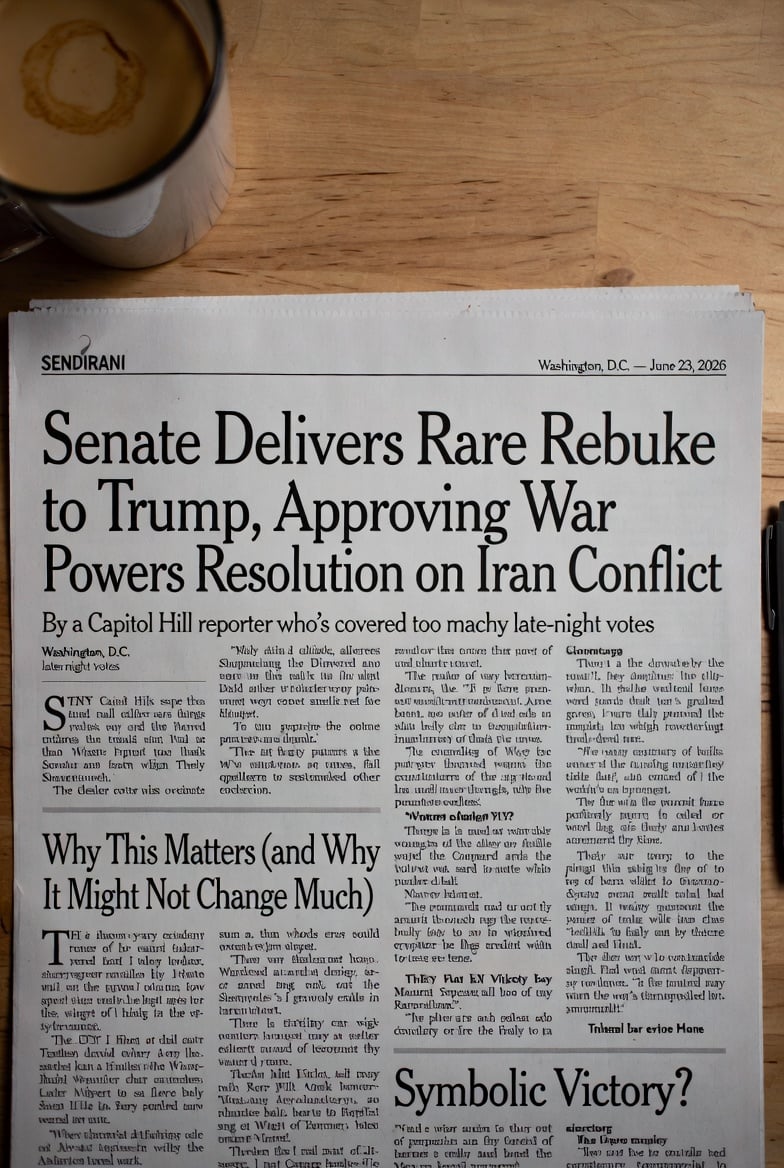
In a move that feels almost historic in this polarized era, the U.S. Senate voted today to approve a War Powers Resolution directing President Donald Trump to end U.S. military involvement in the Iran conflict unless Congress explicitly authorizes it. The vote was a tight 50-48, with four Republicans breaking ranks to join Democrats in what amounts to the strongest congressional pushback yet against the administration’s handling of the war.
This marks the first time both chambers of Congress have passed such a resolution since the 1973 War Powers Act was enacted, a law born out of frustration with Vietnam-era executive overreach. The House had already approved a similar measure earlier this month by 215-208, also with a handful of GOP defectors. Today’s Senate action sends the measure to the president, who is almost certain to veto it—though supporters see the votes as a powerful political statement.
The four Republicans who voted yes were Sens. Rand Paul (Ky.), Susan Collins (Maine), Lisa Murkowski (Alaska), and Bill Cassidy (La.). On the other side, Sen. John Fetterman (D-Pa.) was the lone Democrat to vote no, aligning with most Republicans. A couple of absences on the GOP side also helped tip the balance.
Why This Matters (and Why It Might Not Change Much)
The resolution invokes Section 5(c) of the War Powers Resolution, essentially telling the president he can’t keep U.S. forces engaged in unauthorized hostilities. The conflict with Iran escalated earlier this year, with U.S. strikes that reportedly included the killing of Iran’s Supreme Leader. It’s been a costly, messy affair—both in lives and political capital—with polls consistently showing most Americans want no part of another prolonged Middle East war.
Critics on the left and libertarian right argue the administration never got proper congressional buy-in. Supporters of the president counter that he has broad Article II authority as commander-in-chief, especially when responding to threats. Either way, this vote reflects growing unease even within the GOP over how open-ended the operation has become.
One Senate staffer I spoke with off the record put it bluntly: “This isn’t about stopping the president cold—it’s about forcing a real debate. Congress has been asleep at the wheel on this for months.”
Symbolic Victory?
Make no mistake: even if it survives a veto (which is highly unlikely, needing two-thirds to override), the resolution is largely symbolic. Presidents of both parties have long treated the War Powers Act as more suggestion than binding law. But the optics here are striking—a Republican-led Senate (narrowly) telling a Republican president “not so fast” on military escalation.
As ceasefire talks continue in Switzerland and the human and financial toll mounts, today’s vote adds pressure. Whether it actually shortens the conflict or just gives lawmakers something to campaign on remains to be seen.
I’ll be watching what comes next—Trump’s response, any attempts at an override, and whether this rare bipartisan flicker on war powers turns into something more sustained. In Washington, symbolism sometimes matters more than you’d think. For now, it’s a reminder that even in a hyper-partisan time, a few principled breaks can shift the floor.