

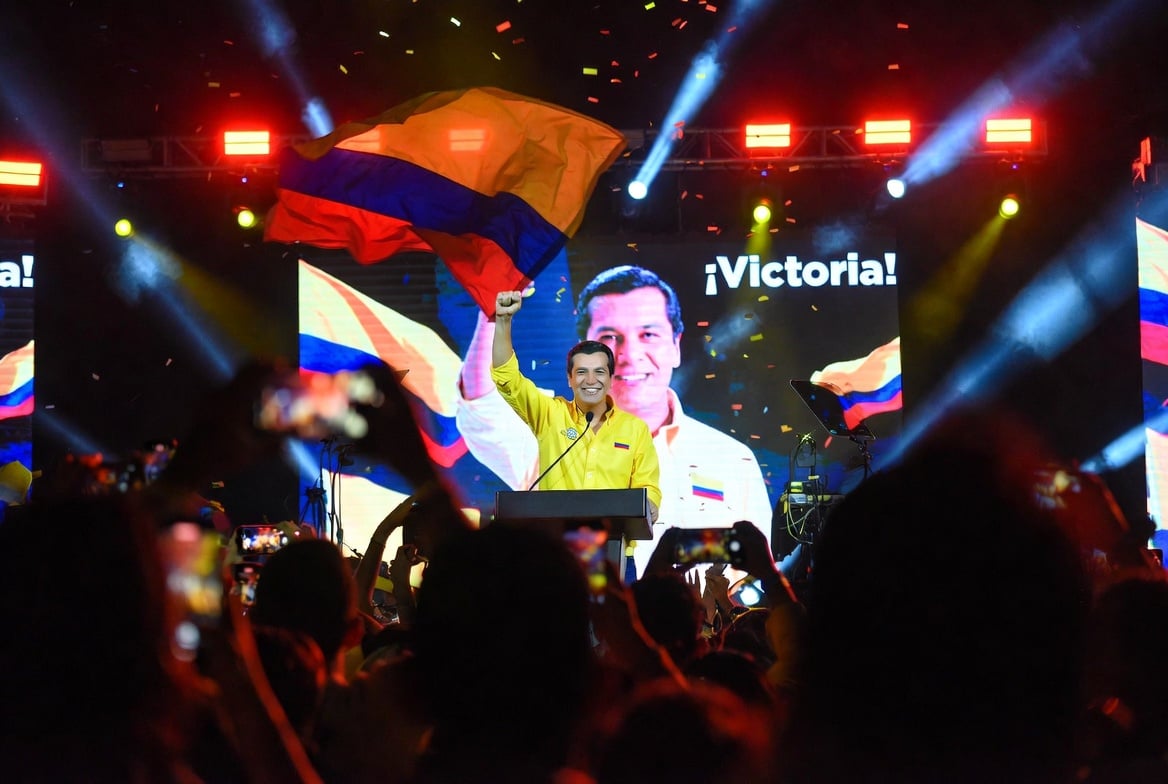
Colombia Elects Far-Right Outsider Abelardo de la Espriella as President in Tight Runoff
Bogotá, Colombia — In a nail-biting finish that has left the country deeply divided, Colombian voters have chosen Abelardo de la Espriella, a Trump-endorsed far-right lawyer and political newcomer, as their next president.
With nearly all ballots counted from Sunday’s runoff, De la Espriella edged out leftist Senator Iván Cepeda by a razor-thin margin — about 250,000 votes — securing roughly 49.7% to Cepeda’s 48.7%.
The victory marks a sharp pivot for Colombia, Latin America’s fourth-largest economy, after four years under President Gustavo Petro, the country’s first leftist leader. Petro, constitutionally barred from seeking re-election, had thrown his support behind Cepeda, framing the race as a continuation of progressive reforms on issues like inequality, climate change, and peace negotiations with armed groups. But many voters appeared ready for a change, drawn to De la Espriella’s tough-on-crime message amid persistent security worries and economic struggles.
De la Espriella, a millionaire criminal defense attorney nicknamed “El Tigre,” campaigned as an outsider promising mega-prisons, aggressive crackdowns on cartels and guerrillas, stronger ties with the United States, and a more business-friendly approach. His style echoes El Salvador’s Nayib Bukele, and he received an explicit endorsement from Donald Trump, which he leaned into heavily. Supporters see him as a fresh break from what they call Petro’s failed experiments.
The first round on May 31 set the stage for this polarized showdown. De la Espriella surprised many by topping the field with around 44% of the vote, while Cepeda, a longtime human rights advocate and Petro ally, took about 41%. Turnout was solid in both rounds — hitting a record in the first — reflecting how high the stakes felt for many Colombians.
Sunday’s voting unfolded peacefully, with international observers praising the process as transparent and orderly, despite some pre-election violence and Petro’s unsubstantiated claims of interference. In Bogotá and other major cities, lines formed early as voters weighed two starkly different futures: continued dialogue with rebels or a harder military hand.
For Cepeda’s camp, the loss stings. He positioned himself as the steady hand to build on Petro’s social programs, emphasizing negotiations to end decades of conflict with groups like the ELN and FARC dissidents. His supporters worry De la Espriella’s approach could reignite violence in rural areas still scarred by the long civil war. Yet the narrow defeat suggests the country remains split down the middle.
De la Espriella, who takes office on August 7, now faces the daunting task of uniting a fractured nation while delivering on ambitious pledges. The economy has been sluggish, crime in cities like Bogotá and Cali remains a daily concern, and relations with Venezuela and the U.S. will likely shift. Whether his “law and order” vision can produce lasting results — or deepen divisions — will define his term.
As one voter in Cali put it after casting her ballot, “We’ve tried talking. Now maybe it’s time to get tough.” For better or worse, Colombia seems ready to test that theory. The coming months will show if “El Tigre” can roar loud enough to deliver the change so many desperately want.